New Frontier Models: GPT-5.6, Claude Opus 5, Gemini 3.6
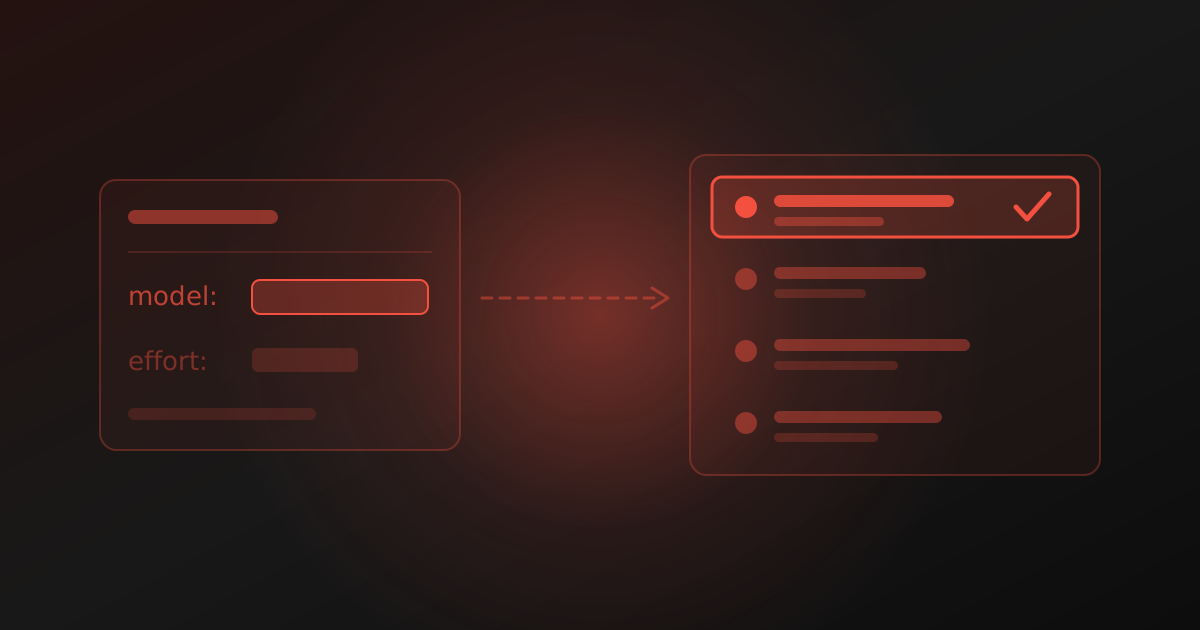
Three providers shipped new generations in short order. All of them are live in Ingram Cloud today: GPT-5.6 in its three sizes, Claude Opus 5, and Gemini 3.6 Flash alongside a new high-throughput Flash-Lite. Moving an agent onto one is a single field — the model id — and nothing else about your integration changes.
Claude Opus 5: a step change at the old price
Opus 5 is the one to reach for on hard, long-running work. Anthropic positions it as a step change over Opus 4.8 on deep reasoning, agentic and long-horizon tasks, and on scaling test-time compute — the case where an agent gets meaningfully better because you let it think longer.
The part that matters for anyone already running Opus: it costs the same as Opus 4.8. Same $5/$25 per million tokens, same 1M-token context window, same feature set. There is no cost argument for staying behind, which is why we made it the Anthropic flagship in the picker on day one.
It also caches more aggressively. Claude models on Ingram Cloud get automatic prompt caching — we place the cache breakpoints on your stable prefix (tools, instructions, conversation so far) on every step of every turn. Opus 5 halves the minimum cacheable prefix to 512 tokens, so shorter system prompts and smaller tool sets now qualify where they previously fell just under the bar. Nothing to configure; watch the cache hit rate in your usage breakdown.
GPT-5.6: one generation, three sizes
OpenAI's new line splits into three named tiers, and the split is genuinely useful because they share everything that usually forces a compromise:
openai.gpt-5.6-sol— the frontier model, for complex professional work and the hardest reasoning and coding.openai.gpt-5.6-terra— the balance of intelligence and cost, for mid-range workloads.openai.gpt-5.6-luna— optimized for cost-sensitive, high-volume work.
All three carry a 1.05M-token context window, vision, and the full tool surface — functions, web search, file search. So dropping to Luna for a high-volume classifier isn't the usual trade where you also give up long context or the ability to see an image. You give up depth, and keep the rest.
The practical shape: put Sol behind the agent that does the difficult reasoning, Terra behind the everyday one, Luna behind the one that runs ten thousand times a day. Same prompts, same tools, three price points.
Gemini 3.6 Flash, and Flash-Lite for volume
google.gemini-3.6-flash is Google's latest, balancing speed against
intelligence for agentic and multimodal work — the pick when an agent is handling
images, audio, or video and you don't want to pay frontier rates for it.
Underneath it, google.gemini-3.5-flash-lite is the fastest and most
cost-effective of the 3.5 line, built for high-throughput execution. It's the
cheapest way to run something at real volume in the catalog.
Reasoning depth stays one dial
The reason a model swap is genuinely one field is that we don't make you learn
each provider's control for thinking. reasoning_effort — the standard OpenAI
field, none through xhigh — is honored whatever model backs the turn, mapped
server-side: to OpenAI's own effort parameter, to Claude's adaptive thinking at
the matching tier, to Gemini's thinking level.
Set an agent to high and move it from Opus 5 to Sol to Gemini 3.6 Flash: the
intent survives the move. That's the point of building on the standard shape
rather than inventing our own.
Your key, or ours
Every model here runs either on Ingram Cloud's hosted keys — nothing to set up, billed as usage — or on your own provider key, per tenant or per end user, so inference bills the account you want it to bill. Setting a key is one call and the choice is per provider, so you can bring your own OpenAI key and stay on hosted Claude.
One housekeeping note: the picker carries each provider's current models plus the previous-generation flagship, and we pruned the older entries as part of this refresh. The catalog was always a convenience rather than a constraint — any model id your provider serves still works if you set it directly over the API, including tiers we deliberately keep out of the picker.
American models, European ground
Every model in this post is American. That isn't in tension with why European organisations build on us — it's the point of the architecture.
We argued in June that sovereignty isn't where the data centre sits: it's the ability to choose which model runs, swap it without rebuilding, keep your data under your own law, and prove afterwards what the system did. This release is that argument in practice. Three providers shipped a generation inside a few weeks, and moving to it cost one field — because the layer that holds your agents, your data, and your run history is ours, and it's European.
Ingram Technologies is a Brussels company, and Ingram Cloud runs on European infrastructure under European law — inside the GDPR and the EU AI Act rather than adjacent to them. The honest caveat hasn't changed: point an agent at a model hosted abroad and that call leaves jurisdiction, because the model does. Everything holding your data and your history stays in Europe — as does the freedom to change your mind about the model next week.
Try it
All of it is live now. Open an agent, change the model, and the next run uses it — no redeployment, no code change, and the run trace shows you exactly what it cost.
See the models documentation for the full catalog and how key resolution works.